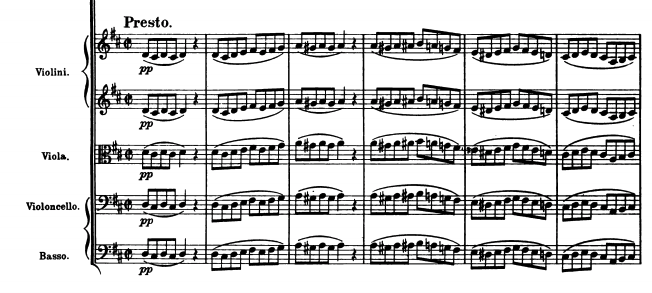
The basses are one of the most ill-understood instruments of the orchestra; pigeonholed to pages of footballs and rests. Yet, their orchestral origin was nearly identical in intent to the cellos – as for most of the baroque and classical era they were doubling each others parts at the octave.
Now consider that modern bassists have all played and studied the continuo parts of the Bach Cantatas and the Mozart Symphonies.
fast Mozart and Bach lines can really move! (and they play surprisingly few whole notes)
They are more nimble than given credit for and can usually handle much more than what is commonly put on the page for them.
Cello + Bass at the Octave is a thing
This doubling always works – high in the range, low in the range, soft, loud, pizz- it just sounds good 100% of the time. Keep them exactly tutti, don’t break the octave to get a low b for example. The lower tones of the piano can confuse the composer (as all of a sudden they get boomy), but remember when the basses play it sounds low. When they play very low it sounds super low.
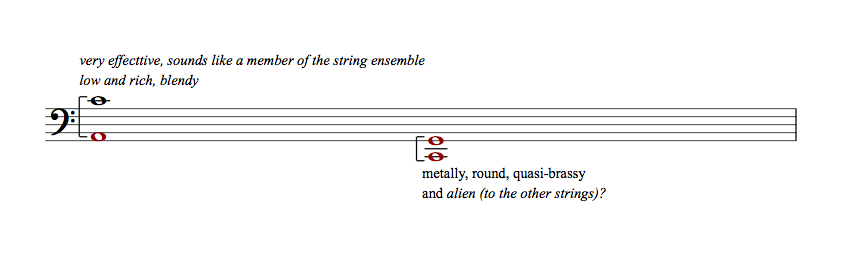
The Low C string isn’t the sweet spot (imo)
I’m calling it the low C string because 99% of professional basses have the C extension, or if you are in central Europe they may have the 5 string instrument with the low B – and feel free to write for it if they do have it!
This is opinion only, but I feel many composers write bass parts too low. To my ears the low C string blends the least out of all the 16 strings in the section. To my ears it can often sound more like a brassy, synthy patch than a blendy, warm string patch. At forte or above it is very sticky-outy -timbre wise.
Therefore I suggest to focus your efforts in this range:
the range on the left is generally better to stay in
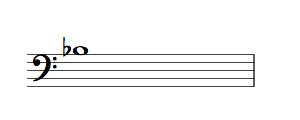
Even on this written Bb the basses will “anchor” the string section. They are huge instruments, and the math and physics of the instrument make all their notes “sound” low – regardless of what the piano shows you.
sounds 8vb
As a composer leave yourself space to go into the low- low range to follow a line – or to use a new color – don’t just use it for no reason.
The low C string just becomes so tiresome when one always hears it. To my ears it just makes the string section sound smaller.
Note: Below the low E – be careful writing stuff too fast or busy here. There is a lot of “fret” real estate to cover.
The strongest transient in the entire string section is the bass snap pizz. I was recently at a scoring session at Warner Brothers and the conductor was very effectively adding snap pizz. contrabasses to beef up huge stabs and it worked very well. It almost drowns out the entire ensemble – they can really blast it.
Announce your preference: Balance The Basses
There are some wonderful and confident bassists in Los Angeles – and when situated in certain rooms they can overwhelm the sections near them (especially if the writing is too low).
To fix this you can have the string section hit and hold a chord and balance it on the spot and then ask them to “preserve that balance”. I do this sometimes with the first violins also, I prefer a democratic relationship between the string sections ( I don’t want any of them to have more power than the others – sounds more tutti to my ears that way – aka I don’t want anyone sticking out.)
In general I find the orchestral forte convincingly loud – I like to save the heavy stuff for special moments or hold it in reserve.
In this series I’m going to start talking about orchestration – specifically for film-style recording sessions at a large scoring stage. Additionally, let’s consider that your are orchestrating someone else’s music and that they composed that music with samples in a sequencer.
Dynamics and Balances
A crucial part of your task as an orchestrator is to set dynamic levels. This has to be done by ear. You can use the CC information as a reference but you must listen carefully to ultimately make the decision. Listen in context, not just via soloing tracks.
Keep in mind these concepts when you are listening to mockup playback:
Composers tend to overuse CC1
You may be listening to extra, artificial gain via plugins (more than you can see via their delivery)
Samples may use larger sections and therefore have artificially louder apparent volumes than what you will have at your session
You have a fixed orchestra size and limited bandwith
Listening Between the Lines
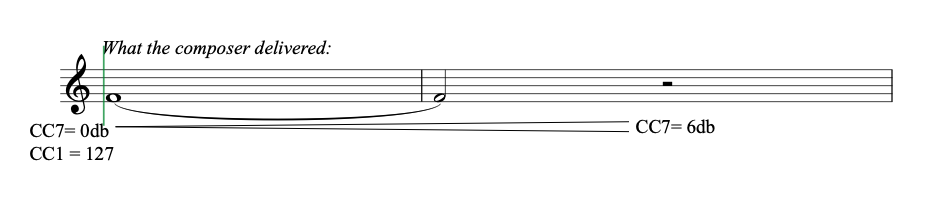
Imagine you had a four horn unison swell, you’ve written down the proper pitch and length and are deciding upon volume choices.
The four horn swell in question
You’ve established that the ending volume is FF but now you need to decide what the starting volume is. (As an aside I very, very rarely use over-FF or under-PP dynamics – there are finer ways to manage these situations).
Well in this example the composer made the swell with only a CC7 gesture – so it ultimately sounds Loud to LOOOOUUUDDDD. CC1 stayed at 127 (max volume) the whole time.
in real life french horns have finite swelling capability
So the question is what should the starting dynamic be? Well if you wrote down exactly what the composer gave you there would be very little crescendo.
So this might be a point where you listen and decide that the swell itself is more important than the starting volume and you change the composers starting to dynamic to P instead of F.
This type of decision making is very common.
Impossible Dynamics
Its pretty common to see things in mockups that aren’t possible in real life. It is common to hear the “barking” sound bass trombones make presented artificially at a PP layer – well to get that barking sound they are going to command the room – you need to decide how to handle that.
You might see the start of swells in the midi that don’t sound in the audio till much later.
Where do you place the start of the swell ?
Via the miracle of gain staging you might hear eight french horns playing forte being overpowered by a low range flute solo.
Well its your job to solve all of these.
Bonus/Pet Peeve:
99% of the time this is bad orchestration – either make that hairpin smaller or adjust the dynamics to be further apart.
Vagueness has been on my mind lately, as I’ve come to the conclusion that some composers are direct and to the point, and others are vague and veiled. I’m trying to tell whether it’s done on purpose or if especially vague composers are only capable of presenting vague music and visa versa.
Size Matters:
I think deep within the composer, there is a desire to favor longer musical ideas over shorter ones. As if a short piece would comment negatively upon their intellect and their inability to develop a musical thought. I think modern classical music has added the concept of complexity over simplicity to this favoring.
A nine minute symphony would hardly be a symphony at all, but 90 minutes could be too much of a good thing.
Brahms, Wagner, and Mahler are all famous for composing titanic pieces of music. But does the increased length in anyway water down the whole at all? Is there an ideal value in minutes to aspire to?
At what point does overly long music start making the listener drift off to think about that after concert drink? I’ve had many professional musicians confess to me they too can even drift.
Beethoven 9 is a long symphony, but it seems to be exactly the right amount of minutes given its construction and nature.
Beethoven was able to do this effortlessly. Even the longish slow moment has tonal and thematic development, varying orchestration, density increases and subtractions, and phrase give and takes. Most importantly, it always seems to move forward in a certain direction, be it though peaks or valleys, but always forward never stagnant, never garnering those extra seconds for the sake of adding length to the work. Never empty bars.
Direct vs Vague
Mozart, Rachmaninoff, and Tchaikovsky perhaps are the best examples of what I mean by direct composers. They employ their compositional choices (mainly their choices of notes and textures) not only to please the listener long term, but to please the listener in the very moment. Let me use an analogy to explain what I mean.
In rap you might know a song by your favorite artist that you aren’t that fond of. Yet within this very song you might a find a miniature moment of lyrical brilliance.
“So where’s all the mad rappers at
It’s like a jungle in this habitat
But all you savage cats
Know that I was strapped with gats
While you were cuddling a Cabbage Patch.”
Even if you hate rap or this song you gotta admit this phrase is dope.
Or you can just be in awe of the beat and be meh about the lyrics
https://youtu.be/Id9nCkVc54s
This beat/setting is very direct, the lyrical content/hook are less so.
Peterson vs Monk
In jazz you might be especially tired of a given standard, but you know that the Oscar Peterson version is going to have some tasty licks in it to enjoy. You know that the Bill Evans version will have some perfectly voiced tonal candies to feast on.
Based on rap, I call this rhyming—it is the major characteristic of direct composers. Regardless of what becomes before or after it, you can enjoy the rhyming while you’re in the moment.
There of course is long form directness and vagueness, but let’s skip that for now.
Oscar Peterson playing directly vs Thelonius Monk playing more vaguely ( I love both versions, for the record).
Oscar Peterson vs Monk on Sophisticated lady
https://youtu.be/RlAKDEPNyFY
Though both are enjoyable, the Oscar Peterson seems to be way more polished and thought out than the Monk. It is also less adventurous tonally than Monk’s “right” wrong note approach. Also Peterson clearly plays the piano with better technique than Monk, if that figures into the equation at all for anyone; it kind of does for me. I’d happily listen to either.
Because he could play so well, he can throw in that occasional miracle lick like the one at 1:33—pure bliss in a single moment—very similar to that Dr. Dre rhyme above. You know the kind of lick that would make someone in the crowd go “ohhheee” involuntarily out of excitement.
Fragment-smithing vs melody-smithing
Beethoven was the best fragment-smith of all time. You could give him the smallest of musical ideas and he could modify it into a perfect musical line.
Look here at the opening of Piano Sonata 30—the first four notes comprise a motif/fragment that he uses repeatedly in the place of a through composed melody.
Yet here in the very next sonata, he relies upon a through composed melody for the opening. These last piano sonatas are utterly perfect—Beethoven understood both fragmentary and melodic style composing.
How hard is it to compose an Epic Item Level melody?
Being a composer myself, I find it pretty hard to compose something memorable that isn’t try-hard sounding. In fact it’s actually very hard to do convincingly. If you under compose your melody, you get a vague and forgettable tune (a common level item); if you over compose it, you end up with an overstated, overly sweet melody that sounds completely try-hard (it’s also a common level item). It is really hard to hit the sweet spot—if you do, you may craft a rare item melody. It is harder still to find a way to craft the melody to sound effortless and unique—if you do, you get an Epic Item level melody.
By the way, a melody doesn’t even need to be a formal “Star Wars” main title type commitment; it can be a passing phrase, a counter line, a clever chord change, or the like—it can be anything remotely melodic or interesting.
Mahler vs Rachmaninoff
After much consideration, I’ve come to the conclusion that I’ll never enjoy Mahler as much as some people. His purposeful fragmentary nature distracts me too much from the landscape of the music—things seem too random and jumpy form-wise for me to enjoy.
By the way, I’m actually jealous of the people who do get him, as I very much desire to and have repeatedly tried to.
I do however get Rachmaninoff, and the second symphony is my favorite of his three. In a further effort to explain directness vs vagueness, let’s compare their symphonies in E minor to each other.
Let’s look at these two examples of them both using an exposed violin melody in the first movement after a lull in the energy and several minutes of introductory development.
Here is the Mahler:
time queue should be around 11L37
Here is the Rachmaninoff:
13:19
If I had to vote for one, I’d have to vote for the Rachmaninoff—he takes that grand orchestration gesture and follows it through to an apex moment—a moment of great climax. A moment that makes the slow opening and spacious development make more sense.
I find Mahler just sort of lets it dissolve into more of the same. When he had the equal opportunity to get to the top of the mountain, he turns around and heads back.
It’s kind of like a comedian prepping a joke, telling the preamble and suddenly deciding to change the topic without delivering the punchline.
I actually find it somewhat frustrating.
Of course Mahler did this all on purpose, probably some rejecting of typical romanticism in the process—it’s just not for me.
Rachmaninoff is frequently criticized for being too predictable, but is it fair to criticize Mahler here for being too indirect? I think so—though admittedly, it’s just a matter of taste. I do wonder if in his mind, he was being direct and it simply sounds indirect for some reason.
Debussy screws everything up
Debussy is the master of manipulating the listener. At his will, he can be vague or direct. He can even do it in the same piece. He can hide the same melody you are in currently in awe of eight bars before you even noticed it. He can go from making 1% sense to 10% and carefully work up to 100% and back down to 20%. In this way, his music flows in a way very unique to him. It is long form music—a wide aspect ratio musical landscape, pleasing in the moment and in the whole.
He was certainly aware he was doing this; just listen to his piano pieces—they can be forwardly melodic in nature or nearly invisible, relying only on rhythmic fragments.