Notes on Notation: Exploiting Vagueness In Notation
When I was studying at USC my venerable professor the wonderful composer/orchestrator Jack Smalley told us “if you’re scoring something uncomfortable make the orchestra uncomfortable.” He was speaking specifically about composing jumping large intervals while a series of jumps occurred in the film. Sort of like this example below (which I think is similar to the one he showed at the time.)
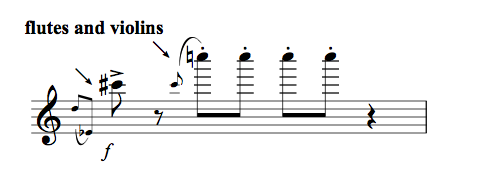
The inherent concept being that the natural stress of the orchestra (via the playing of jumps) would come through and make the cue more stressful sounding.
It’s also a sort of musical onomatopoeia which you can hear in frequent use in film scoring (bees sounding “swarmy” in the score, falling cartoons with falling chordal wind motifs and the like.) Even in classical music the onomatopoeia exists with the Vaughn Williams “The Wasps” perhaps being the most famous example.
I’ve discovered a useful tangent to the use of literal, finite musical notation Smalley taught us – the negation of it – vagueness.
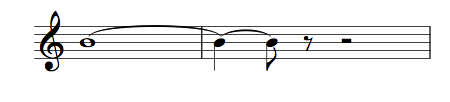
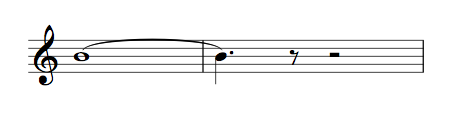
At first glance you would think these two note values are identical, but if you put this in front of a jazz ensemble they would be played distinctly different.
The first would have a “release sample” placed directly on the beat and the second wouldn’t.
The tied eighth makes all the difference. In Los Angeles studios – the tied eighth note gives you a hard off value just like in a jazz ensemble.
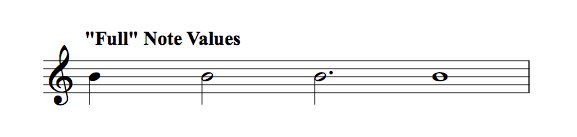
I’ve found whole values like these (above) also have a sort of universal agreement – less concrete than the tied 8th but mostly uniform.
But if you are looking for a more tapered release you can use vagueness to your advantage.
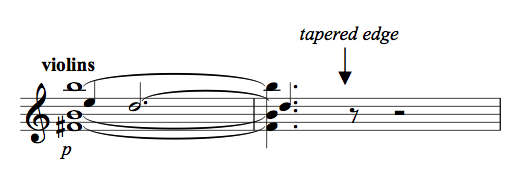
Due to the purposeful vagueness in the notation not everyone is going to release at the same moment – and thus the note ends with a delightful blur. This is especially useful when you want to subtract players from the ensemble without the listener noticing them.
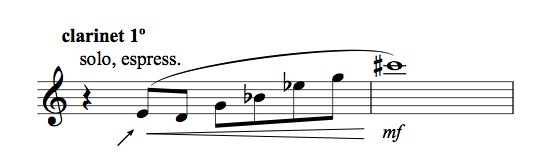
In this solo clarinet example I’m purposefully unclear what dynamic the start of the hairpin crescendo should be – this asks the performer to use their audio context clues or instincts.
In this example I’ve given a written instruction to gradually slow down trem. – instead of of trying to do any sort of fancy notation with feathered beams. Its clearly notated but I don’t think any two players would do it exactly the same.