In the modern world It’s pretty rare to find the time to sit down, put on an album and listen to it in its entirety without distraction. Most listening is a track here or there, in the car, or on Alexa while making dinner or on the headphones while walking the dog. However that doesn’t mean the brain isn’t paying attention.
I think many people find this passive listening, or listening while the brain is mostly occupied with another task, to be a waste of time but I’ve never thought of it as such. I’ve found it to be indispensable.
Just like the rest of the brain – the musical brain seems to have an active and inactive part – or conscious and subconscious using more familiar terms.
A conscious musical thought might be “what is the next note of this melody?” whereas a subconscious musical thought might be “do these bars I just composed relate to the bars before them? or does it sound more like it’s own piece?”
I find when I am considering such matters my thoughts delve into a deep part of my brain where there are no crystal clear answers. In these instances I think what the brain is actually doing is comparing the item in question to your memory bank of music you’ve ingested passively or actively. It is comparing it and seeing if it meets the norm for what is convincing enough to be believable.
If you were writing the closing to a classical piece you might want to consider if your music sounds “ala finale” or “introductory” in its nature. I think the only way to do this is is to listen to a ton of music, more than you could ever listen to in formal study (active listening).
I have a very simple answer: when your ear no longer holds back your brain you’ve done enough ear training. If you can hear any melody or chord in your head and find it with your fingers 100% of the time (even if it takes a moment) you are in a good place as a composer.
If you are struggling with the finding of desired pitches narrow it down by asking yourself if the unidentified pitch is higher or lower than your current audition pitch.
If you’ve tried the higher than/lower than method and haven’t succeeded, try singing it to yourself and finding it that way.
If you fingers can transcribe everything your brain hears – congrats! – you’ve qualified for the big game. Now you just need to spend the rest of your life continuously expanding your palette – and that takes a different type of training (I’ve covered some of the basic concepts in this youtube video).
If you are improvise/perform ala jazz you might wish to continue your ear training to reduce the time it takes your finger to identify the note.
Musicians nearly unanimously refer to Mozart as the hardest composer to master. He requires the highest agility to play, physically and mentally.
I think the majority of Mozart players who fail at Mozart fail mentally. Logically there is no other explanation as we have heard them convincingly play much harder works. Listening to masterful Mozart playing is among my joys in life. Here are some discoveries I’ve made as to what you are actually hearing when you hear “good” Mozart on the piano.
Smoothness and Long Phrases in Mozart:
Mozart requires the pianist to compensate for the natural tendencies of the fingers and instrument.
If one applies equal pressure to the piano in this range there is nearly always an increase in apparent volume while going upwards.
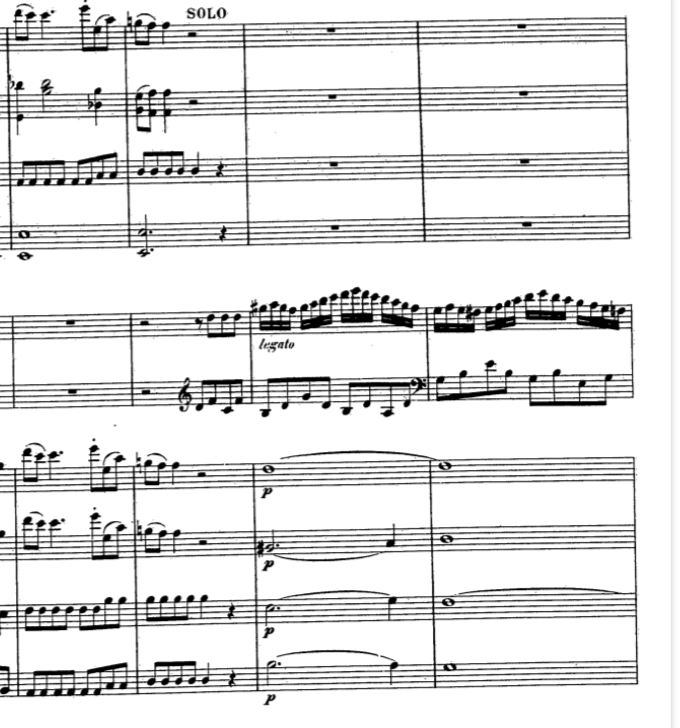
For example in this excerpt (above) the piano will want to crescendo on the the bar marked “legato”.
The pianist must resist this and remain neutral in order to play the long phrase (all of the 16th notes are one phrase).
The fingers will also want to set anchor points where the direction of the scales change but this too must be resisted. The line needs to be continuously gradual.
It takes a bit of sustained effort and compensating to do this.
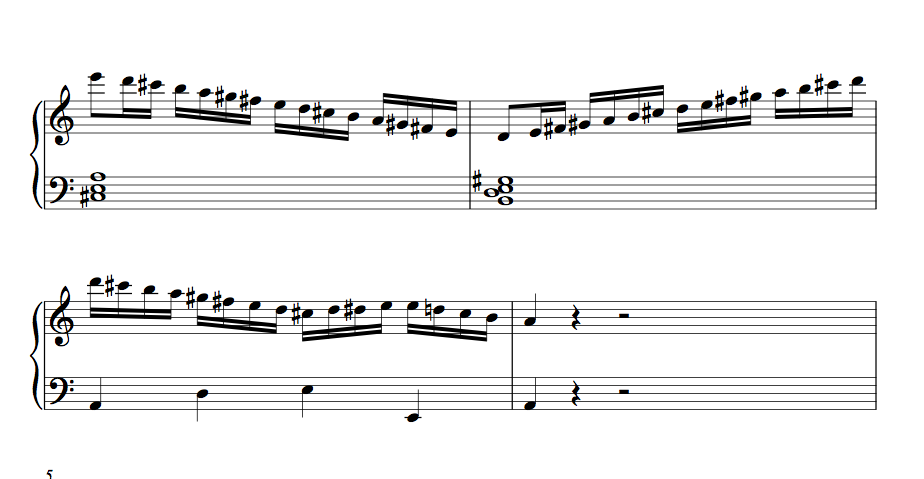
The pianist must mask the 1-4 and 4-1 crossings to smoothly present a long line
In this phrase (above) the fingers want to bring out the 1-4 (downwards) and 4-1 (upwards) finger connections but the brain must resist it.
The fingers also want to set the E natural (the second note of the second bar RH) as an anchor point of a large scale but the brain must resist it and place it dynamically appropriately.
Listening To The Instrument
Slow movement Mozart often requires the pianist to be aware of the decay of the piano and to align the dynamics of the new notes to match the decay of the old note. This is the truest form of decrescendo/legato on the instrument which has no true monophonic legato.
This phrase is surprisingly hard to keep “weightless”
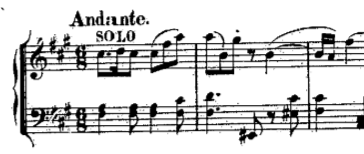
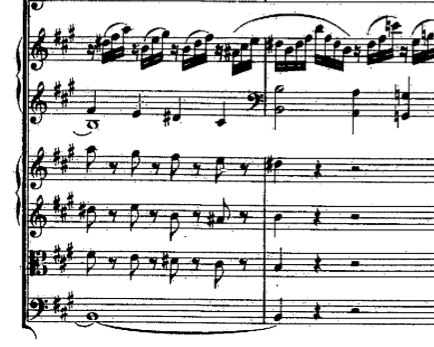
In this example (right) the low E# in the left hand has the tendency to punctuate the texture and interrupt the right hand melody which despite having a rest appears as one long line.
Sensitive pianists will listen to the decay of the F#/D chord and place the E# in that same area (which is really contrary to what the fingers want to naturally do – they want to play it heavier).
There are also times where the hands are equal partners.
What is the more likely rhythmic motif of the right excerpt – continuous sixteenth notes? or a sixteen rest followed by three sixteenth notes?
It is A for me – continuous sixteenths – which hand the motif is played on is secondary – it doesn’t matter.
There are also times where taste comes in.
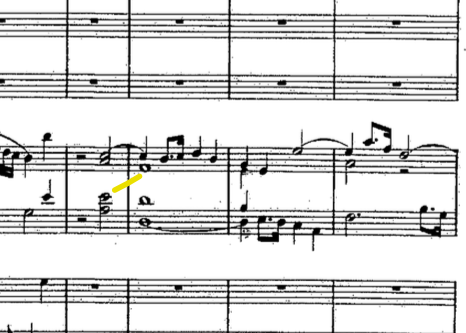
Out of all the moving voices in this A to D major chord passage I think the yellow line is the prettiest.
Orchestral Awareness
Another thing I notice is high level Mozart is that the pianist is obviously aware of the accompaniment.
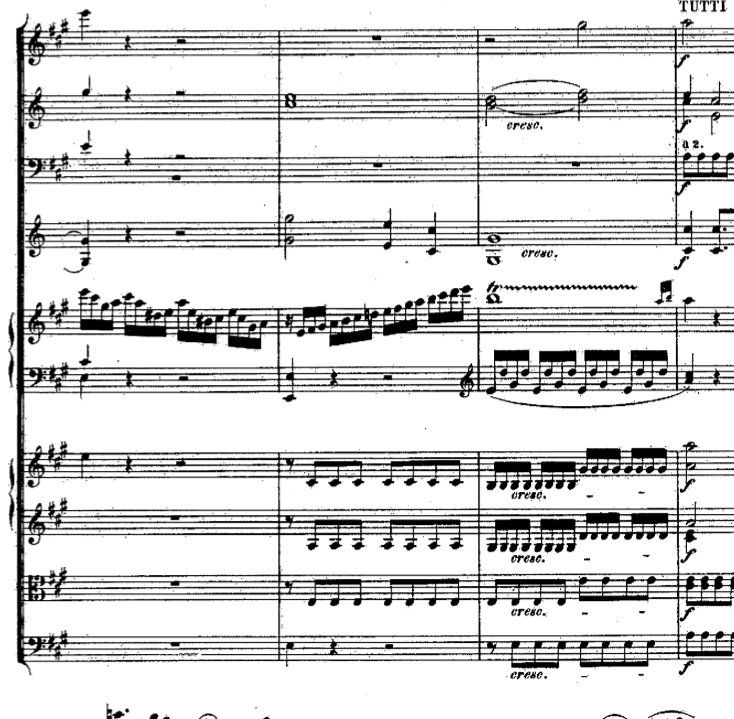
The french horns have the tune in the second bar above
Most pianists anchor this low E (second bar) octave seemingly unaware that it is part of the blooming French Horn line which blooms more convincingly if the piano doesn’t obliterate them on the first beat.
Sometimes you hear a pianist using a “pizzicato” touch when doing trading passages with pizzing low strings.