Newly Premiered Works: Arise

Michael BarryClassical Music Leave a Comment

Two weekends ago I had the honor of having two of my compositions premiered here in the Los Angeles Area.  The first called “Arise” was premiered by The San Bernardino Symphony under the baton of Anthony Parnther, and the second entitled “Lamentations” was premiered the same night by Thomasz Golka and The Riverside Philharmonic.

Quite interestingly, the pieces were literally played at exactly the same time so I had to choose which concert to go to.  Fortunately, a second performance of the Riverside Philharmonic was scheduled for the following afternoon so I was able to attend one performance of each piece.

I’ve attached the computerized Sibelius playback of Arise below (obviously Katherine Liner’s lyrics sadly won’t playback via this method).  

The AFM Contract for the musicians of both orchestras was for performance only – they are required to be paid extra for recording services.  Even if there was a bootleg recording of these pieces I would choose to not use it as these players work very hard for the amount of money they are paid.  In a perfect world I would love for them to be paid twice or even thrice what they receive but of course funding is always an issue when large ensembles are together.   I recently rejoined  local 47 (AFM) and am doing my best to support the musicians in my community as best we can – and unionization is one of the best ways to do this.

This work has obvious references to other joyous and celebratory pieces.  One of my favorite albums of all time is “Summon The Heroes” and I’ve listened to that album so many times that I am certain much of the music of Williams and the other composers on this album has crept into the composition.  When I first started writing the work on the work I had just attended a concert of “Titanic” live orchestra to picture so I can even hear some Horner influence in the work.

Arise isn’t written in a full classical language; I purposefully kept it “somewhat cinematic” and very accessible.  Another piece I wrote in a similar language to this was “Endeavor”, a work for wind ensemble. 
Mozart Recitative Chord Change Generator

Michael BarryClassical Music Leave a Comment

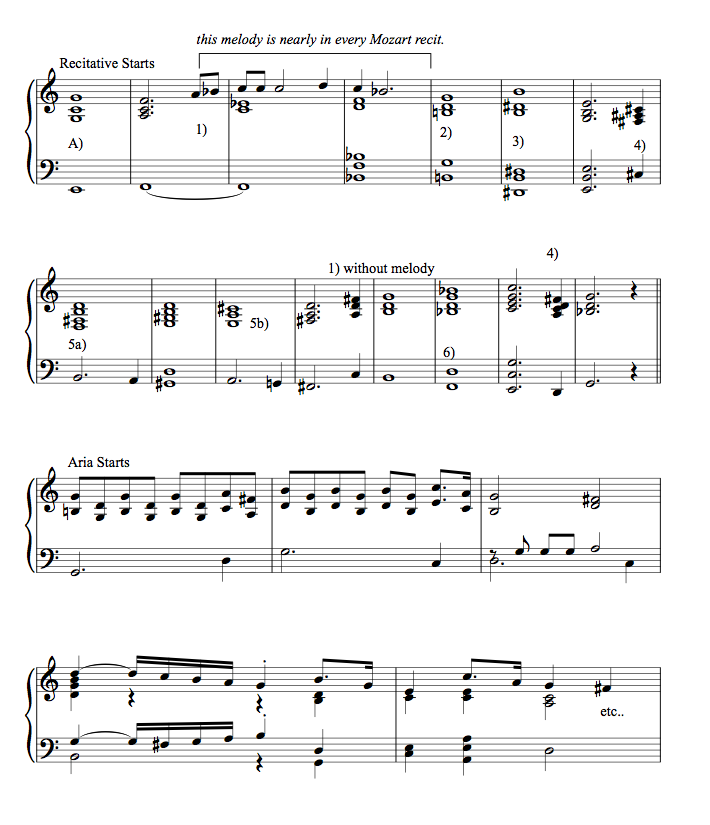
I made this fun little musical recipe to make your own recitatives Mozart style. Of course the Master uses way more tricks than this but this is enough to get you started and cover 75% of His applications. 

Its quite hard to type figured bass in a web browser so pardon by ghetto notation.

Global assumptions: 

  • a)  I can be swapped for i unless specifically mentioned
  • b)  I and i inversions can be swapped for root position 
  • c)  “Five of” Tonics can either be Triad or Seventh in nature
  • d)  proper voice leading is preserved – continuo improv. is encouraged

Position X) Starting From Major Chord (or minor chord but these recit. seem super rare)

TO:

A) directly to V (Major) which becomes the new tonic – back to X 

1) to the IV via I7 (possibly with a melody similar to what is notated) IV becomes new tonic – back to X

2) Direct modulation to VI – Back To X 

3) Modulation to vi:i via III6 – vi (or VI) becomes new tonic – back to X 

4) Direct modulation to III via II:V to III:I – back to X 

5a)  from a minor chord: step down to the 7  then IV(642) resolving to IV or iv – which becomes the new tonic – back to x

5b)  from major: step down to 7 then IV6:I 

6) from major to relative minor 64 to II7 over #4 

Audio Of The Score
Recit. accompaniment – imagine singers covering plot details in between songs

WHEN READY TO END RECITATIVE then use I7 to V:I  or choice 4 – start new piece 

A Chart/Concept to Keep Your Listeners Interested

Michael BarryClassical Music, Composition Leave a Comment

When a viewer observes a painting there is a “oh, well there it is” moment when the frame is first presented – it is first taken in as a whole and then the details are discovered upon closer examination. 

Music is also largely in the moment – details first – and then the whole comes second if it comes at all.  The conclusion of Tosca is powerful in the moment (due to it’s orchestration and setting) but even more powerful after sitting through a two hour love story. 

Keep in mind that only the best listeners (maybe 10%) have access to musical recall upon a first hearing.  During a first listening the average listener is  sort of engulfed in a vague musical energy rather than any concrete quasi-analytical musical experience (where they recognize form for example).  It takes many listens to achieve that sort of familiarity with the piece. Regardless of the language you use they will like or dislike the piece based upon how convincingly you executed your plan.

All of my personal favorite composers not only engage on the whole but also “live” or in the instant.  Mozart does this over-the-whole by developing and bringing back old material, and live by using beautiful suspensions, tasty melodies and  clever counterpoint. You are satisfied twice. I currently dislike Mahler ( I hope to learn to like him) because it is all too much in the moment, there is a lack of arrival and departure points (sensical musical architecture). PS. I know Mahler did this on purpose, and he is a wonderful composer of course – just not my favorite. 

I think clever is the key word here.  It takes cleverness to impress.  Just the way a clever author leaves a climax at the end of a chapter, and you turn the page with all possible speed. 

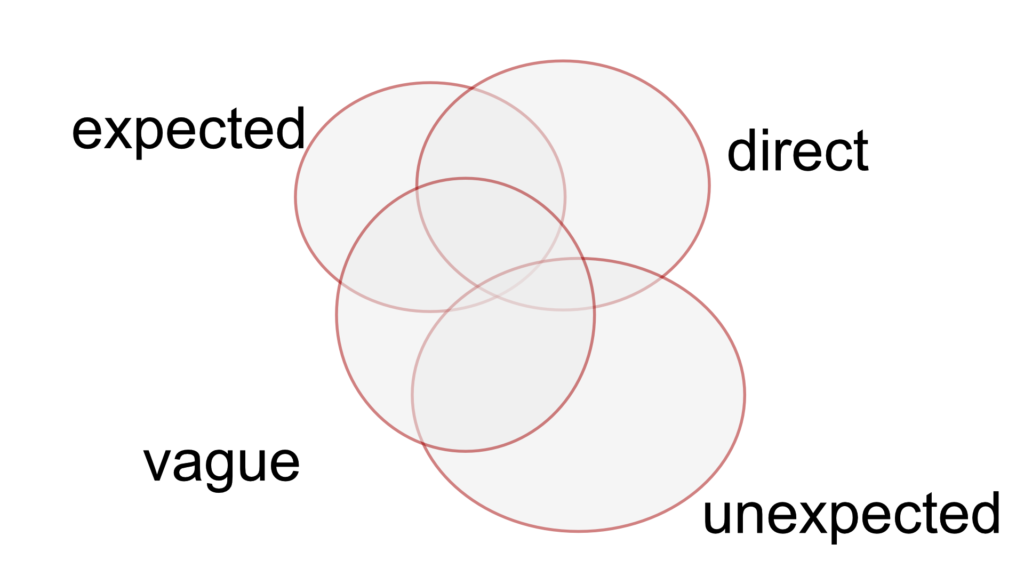
Here is a chart I made – its a “to scale”  Venn-Diagram for what I consider “modern classical music”.  

vague and unexpected seem to be the two key parts to post-modernism

Inside this chart you really want to stick to the middle – occasionally venturing in a direction  that departs from the center point, but always back to the middle then out again.   Back and forth, give and take.

Consider if you go too far in any one direction, you risk disappointing: 

too “expected” becomes overly-simple and boring 

too “vague” leads to scratched heads (and not in that  “good way”)

too “direct” becomes overly-cinematic and not-classical

too “unexpected” starts to sound like multiple pieces, instead of one 

This chart is usable in any type of music, with any type of harmonic langue and parameters. 

I find a lot of modern classical music overuses a Moderato tempo – and one becomes sick of it’s overly-expected energy level (whereas a fast or slow energy might break the monotony.) 

Overly eclectic music often takes  the unexpected too far – if we are in a Baroque-ish vibe and suddenly a steel drum solo breaks out it doesn’t often convince the listener that it’s one entity. 

I find a lot of modern film music too direct – I’ve heard it all a million times before – start to zone out. 

I find Enimem gives me a nice balance of all in terms of lyricism and music, the beat drops for a few beats, a clever lyric follows, a half-a-chorus follows that (instead of a full one) etc.. 

John Williams’ Prisoner of Azkaban score is very much in the middle of this graph, it has tons of unexpected energy but sounds like its all from one score. 

And of course the Rite Of Spring is just about a perfect example of chart-management.

But mostly when composers are hitting in the middle of that chart they are at the ultimate top of their game for that particular piece.  It is very, very hard to do.