Exploiting Your Audience

Michael BarryClassical Music Leave a Comment

Last night I watched a highly controversial movie (who’s title I shall omit). This was a movie that won awards in multiple categories and was generally embraced by the public. I had a major problem with it, and to me it is the same problem facing the arts.

I’ve previously described musical vagueness in this blog post. It is an indispensable tool for any artist. But there is a danger using this technique.

Perhaps you may remember the end of Pulp Fiction, the famous suitcase scene in the diner. Well this is a masterful example of Tarantino using vagueness appropriately. He could have easily showed what was actually in the suitcase, but by withholding that information he makes the viewer infer. It might drive the viewer crazy, not knowing whats in that suitcase, but that is the design of the ploy.

Consider Wagner using a never resolving phrase in Tristan and Isolde. Filled with angst until the last few moments of the opera where he relieves the tension and resolves the chord. As an aside, I’ve always hear the “non-resolving” Tristan chord resolution as a perfectly acceptable resolution. I don’t hear anything particularly “wanting” about it. Again this is a masterful artist playing honestly with vagueness.

I copied this from google, of course there shouldn’t be duplicative rests at the end of the phrase

Lessor artists have noticed the concept behind this technique and many have attempted to use it themselves. The problem arrises when the vagueness they employ is simply charlatan in nature. Whereas Wagner’s vagueness is purposeful, honest and true – a charlatan usage is exploitive – and thus the average viewer/listener who cannot tell the quality of the ploy is easily hoodwinked into thinking it is also masterful. The technique itself becomes the feature, rather than the material.

It’s like a director using some random item in the closing moments of a film in an attempt to play off of Citizen Kane’s Rosebud. If they make it vague enough 90% of the audience won’t be able to tell their effort is not genuine- and THAT is the major issue with it, it is dishonest. If you sit and think about it – that item makes no sense at all, but the director doesn’t count on anyone thinking and thus they falsely, and rather easily, become a master in the eyes of the simpleton public.

If a character starts dancing or laughing in a situation where they clearly shouldn’t be then suddenly this character is dark and complex and anything goes. But if the activity is simply some random crazy behavior, instead of a carefully curated, plot supported activity- it is a dishonest use of the technique. In Gangs of New York, Bill the Butcher caresses the dying priest after just having slain him – it works marvelously given the complexity of the character and later examples contribute to the realistic, but subtle ,contradictory nature of the character. It shows a relationship between Bill’s respect of his enemy and his desire to murder him. Hannibal Lecter is especially frightening because of his high brow aristocratic manner and his pure madness. It is backed up dozens in a dozen different ways during the movie/book (ie: Using the Goldberg Variations while he murders the police officers, or his incredible politeness to Clarice at her first interview). One can easily elicit this technique by having a widely contrasting character, but if it isn’t backed up with some substance it is charlatan in it’s nature.

So much modern classical music is like this. Composers simply hide behind this concept because they lack the capacity to use it honestly. The audience can’t tell any better (and quite often the critics can’t either) and they simply go along with what they are told. Now of course there are wonderful modern composers who genuinely can pull this off, the majority exploit.

I especially hear this with less than tonal music. There is a certain beauty to be found in the quality of a certain atonal cluster. It takes work and technique to making it sound uncomfortable, or to use it effectively. One can’t simply throw golf balls down the keyboard – the notes still matter even though they are atonal. So many composers dishonestly hide behind atonality because they lack the ability to do it effectively, as shown in this Ligeti example. Since the audience can’t really tell, they make a quick buck out of it. Drives me nuts!

A true master at work

Should you like to explore more on this topic check out this very interesting documentary.

“Is this art?”

Working With Headphones

Michael BarryClassical Music Leave a Comment

Headphones sometimes get a bad rap in our industry as being unreliable, and quite often that is the case. For example many headphones have strange things going on the bass regions where their sound can be boosted or missing.

However I’ve found that I work best with headphones, and if one is quite careful with output levels (to protect the ears), quality work can be done on them.

I have many pairs but these days I mostly rely on my HD800’s to do most of the heavy lifting. They are the most detailed listening experience I am aware of. Alex Temple first showed me his pair in 2012 and I was hooked.

https://www.sweetwater.com/store/detail/HD800S–sennheiser-hd-800-s-open-back-audiophile-and-reference-headphones

On occasion they do have bass management issues so I always listen a second time with my pair of Bose Bluetooth Headphones to check the bass – and other levels.

The key with headphones is to really learn them. You must listen to hours of music you know very well to see how they respond.

I do have a pair of monitor speakers (Focal Solos) but they are at Hollywood Scoring Headquarters!

Notes on Notation; Using The Right Tool For The Job

Michael BarryClassical Music, Education, Orchestration Leave a Comment

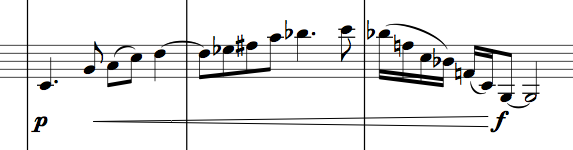
In classical music notation you see a bunch more cres. and dim. than you see in film score notation.  Film score notation is almost purely hair pin dynamic changing.   Can they be used interchangeably? Sure, sure they can but I think it is best to use them more cleverly. 

hairpins (below) and text modifiers (above)

How I use hairpins and cres. and dim.

I have a very specific idea of how to use these dynamic modifiers in music.  If I want a specific length cresendo, starting and ending at a certain point I use a hair pin.

If I want to leave it up to the performer’s instinct I use the word.  

So basically the concept is; If I am going to be really specific about it I use hairpins – if I want to give some liberty to the performer to phrase it in their own I use the words.

this is me telling the player EXACTLY where to crescendo
this is me giving the player some liberty over the crescendo

If you want to have a generally increasing line with some give or take you should use both.

Rachmaninoff using both – he wants a general and overall crescendo but he also wants a temporary departure to get those little hair pins. In general the dynamics move globally according to the text notification.

Refining this concept further: 

A) Since hairpins are the mainstay of studio players I’ve found that if I do write “cres.” and “dim.” sometimes they are ignored on the first pass.  If I remind the players to consider these text modifiers then everything is fine.  I’ve noted that some places outside of LA and London simply don’t read dynamics – that is something to consider as well.

B) Since hairpins are more exact they tend to work better for quick dynamic changes where multiple persons are involved. (like in a large section)

C) Text modifiers seem to work much better for solos and expressive passages.  As I get older and more confident as a composer I find myself wanting to hear how some of these excellent orchestral musicians can contribute to my work – this is an easy way to allow it.  

If this was written for a solo clarinet they would be tricked into autopilot and the crescendo would be linear and unmusical – this does little for me musically
If I wanted the clarinetist to phrase the crescendo in a musical way and according to their own taste I would write this. (And to be clear this is actually how I would write it for a proper soloist chair)

D) Text modifiers allows your conductor to be involved. There are several excellent classical conductors in Los Angeles who also conduct sessions. They are capable of shaping things in a very musical way if you leave them some room to function.  They can do more than wave a stick to click if they are given room to do so.

Rallentando vs Ritardando (ps this is just my opinion)

These words are used more or less interchangeably by most music folks these days.  They both imply a slowing down of the tempo but is there any more to it?

Personally I tend to think of Rallentando as a “holing back” of the tempo whereas Ritardando can be more of a linear tempo change.   Rall. to my brain seems to have more awareness of the tempo it is coming from whereas rit. seems to be less interested in the previous tempo, but more interested in the slow down.

Additionally sometimes I write “holding back” as a direction – I feel it is an easily accessible to conductors who can literally feel the orchestra fighting their tempo change.